
The short answer
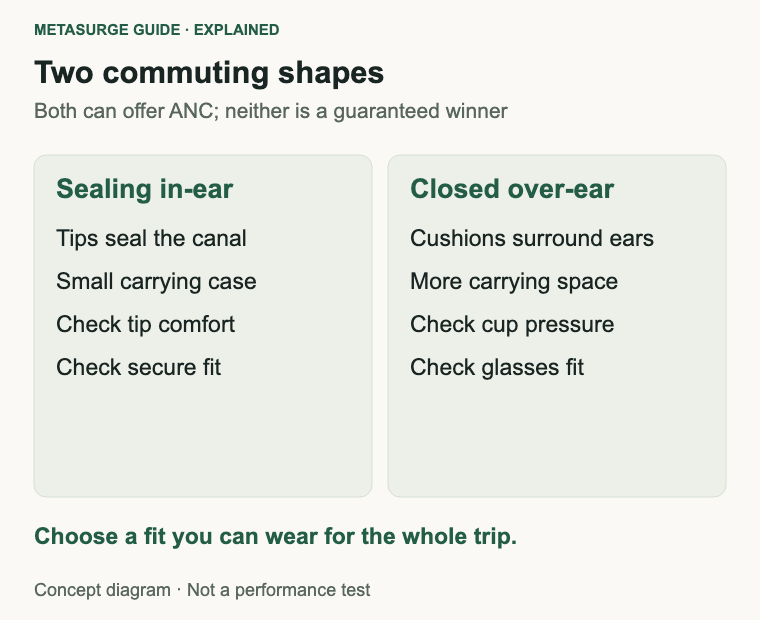
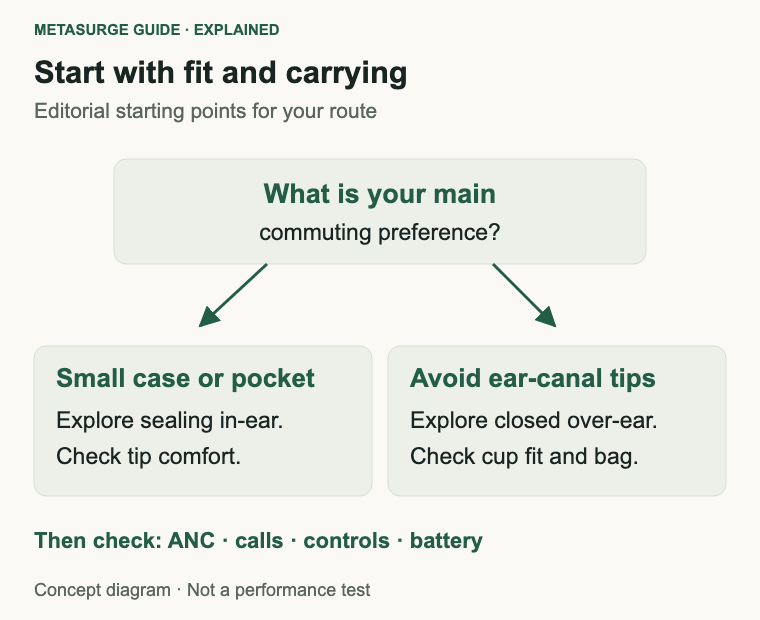
In-ear headphones are the practical starting point if you want a small case, travel light and don’t mind ear tips. Closed-back over-ear headphones are worth considering if you dislike having something in your ear canals and have room to carry them. Neither shape guarantees better noise cancelling, clearer calls or better sound.
For a commute, choose the fit you can tolerate for the whole trip, then compare the actual model’s isolation and features. A train journey with a backpack creates different needs from a short walk with only a pocket. If your current headphones stay comfortable and let you listen without constantly adjusting them, changing shape may not improve the journey.
First, separate shape from features
In-ear headphones usually use tips that sit at the entrance to, or inside, the ear canal. Here, “in-ear” means a sealing tip design. Loose-fit earbuds and open-ear designs are different: they don’t create the same seal and shouldn’t be assumed to offer the same passive isolation.
Over-ear headphones use cushions around the ears. For this commuting comparison, the relevant designs are closed-back models. Open-back headphones intentionally allow sound through the outer earcup and generally aren’t the sensible starting point for a noisy carriage. On-ear models, whose cushions sit on the ears, also fit differently from the over-ear designs discussed here.
Wireless is another separate choice. In-ear headphones can be wired or true wireless, while over-ear headphones can use a cable, Bluetooth or both. True wireless means separate earbuds with a charging case. Shape alone doesn’t tell you whether you’ll need a charged battery, an adapter or a particular phone connection.
Which blocks train and bus noise better?
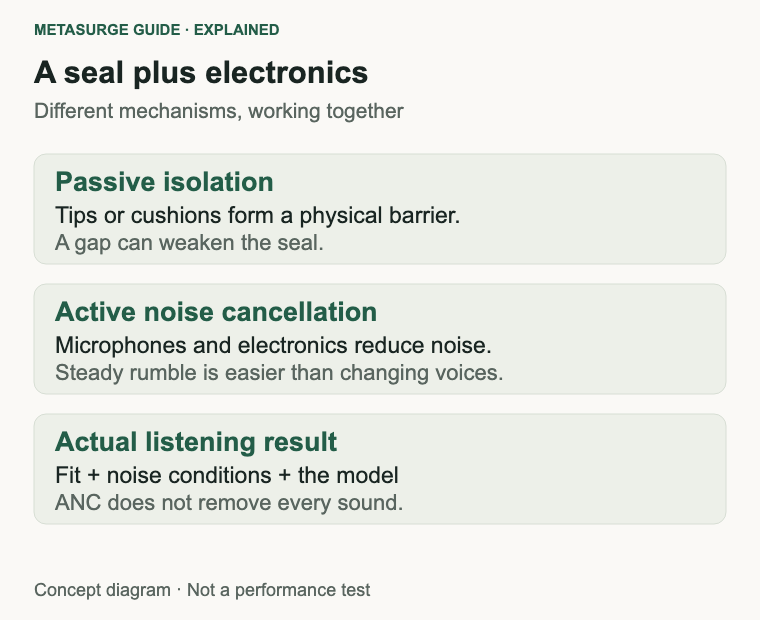
Passive isolation is the physical barrier created by ear tips or ear cushions. Active noise cancellation, usually shortened to ANC, uses microphones and electronics to reduce external noise. They work together, but they are different mechanisms. A good seal remains important even on a model with ANC.
ANC generally works more effectively on steady low-frequency noise, such as engine hum, than on changing voices or sudden sounds. That doesn’t mean announcements will always remain easy to hear. It also doesn’t mean every ANC over-ear model beats every ANC in-ear model; implementation and fit matter.
For earbuds, start by fitting the tips correctly. Try the supplied sizes and any fit check the manufacturer provides. Your two ears may suit different sizes. A tip that’s secure without painful pressure is more useful than choosing the largest size simply because you assume it must block more sound.
For over-ear headphones, adjust the headband and place the cushions around your ears. Glasses, hair or a hat can interrupt the seal. Check with the glasses and clothing you actually wear on the commute, rather than judging the fit with everything removed. If sound or cancellation changes when you gently reposition a cup, fit deserves attention before you judge the electronics.
Don’t compare noise-cancelling percentages printed by different brands as though they were a shared test score. The claim may depend on frequency, conditions and measurement method. Use the feature as a reason to investigate the model, then check evidence about the conditions that matter to you.
Comfort is personal, and the trip length matters
An in-ear design avoids a headband and leaves the outside of your head uncovered. That can be convenient, but some people dislike the sensation of a seal or repeated insertion. Try the manufacturer-approved fit before dismissing all in-ear headphones, while recognising that a comfortable tip for someone else may not suit you.
Over-ear headphones avoid inserting tips into the canal, but introduce cushion pressure, a headband and more material around your ears. Cup size matters: a model described as over-ear may still press on part of your ear if the opening is too small for you. Wear them for more than a moment if you can try them in a shop.
Consider the whole route. If you walk to the station, ride for a while and then keep listening at your desk, your total wearing time exceeds the train trip. Check comfort with movement, your glasses and your hairstyle. A design that’s fine while seated can become irritating when you repeatedly put it on and take it off.
Treat slipping, pressure and heat as reasons to reassess fit. Don’t assume discomfort is the price of getting better sound, and don’t buy a second model with the same fit problem just because its specification sheet is stronger. Your ability to wear it comfortably is part of its usefulness.
Pocket space, bags and taking headphones off
A small earbud case can be easier to carry when your bag is already full. Check its real dimensions and how easily it opens. You’ll also need somewhere to put the buds when you stop listening; placing loose earbuds in a pocket creates an avoidable chance of losing one.
Over-ear headphones need more carrying space. Some fold, some swivel flat and some do neither. A folding claim doesn’t tell you whether the supplied case fits your bag. Check the packed dimensions and whether a protective case is included or needs buying separately.
Think about interruptions. Can you pause playback and remove the headphones while holding a bag? Can you put the earbuds away before approaching a ticket gate? Controls that are awkward with your normal routine can matter more than an extra sound mode you rarely use.
If your route includes rain or exercise, check the exact water-resistance guidance. An earbud rating may not cover the charging case, and a rating doesn’t make every kind of exposure acceptable. Keep the device within the manufacturer’s stated conditions and dry it as directed before charging.
Make a carrying check before choosing: put a case of similar dimensions beside your phone, wallet and travel essentials. For a headband model, allow room for its protective case rather than only the folded headphones. This simple check can reveal a poor match before you spend time comparing sound features.
Battery claims need a closer read
For true wireless earbuds, distinguish one-charge earbud playback from the total that includes recharges in the case. A headline total doesn’t mean you can wear the buds continuously for that long. Look for the playback figure with ANC enabled if that’s how you’ll use them.
For over-ear headphones, check listening time under the relevant mode and the charging connection. If you want a cable as a backup, confirm that audio actually works through it when the battery is flat. A socket, charging port or included cable doesn’t establish that behaviour by itself.
Compare the battery routine with yours. You might be happy charging at home each evening, or prefer replaceable batteries or a wired design that doesn’t need charging for playback. Manufacturer runtime estimates are useful planning information, but your volume, calls and settings can change actual endurance.
Also check what a quick-charge claim means. A short recharge may be enough to finish a journey, but only under the conditions the manufacturer specifies. Don’t let that feature substitute for a battery level you can easily check before leaving home.
Calls and device switching are separate checks
ANC for listening isn’t the same as microphone noise reduction for calls. The first reduces noise you hear; the second tries to reduce noise sent to the person on the other end. A listing mentioning noise-cancelling microphones may not be promising listening ANC at all.
Neither headphone shape guarantees a clear voice call outdoors or in a noisy carriage. If calls are a major use, look for evidence covering the microphone, not just praise for music playback. Wind and competing voices are useful things to check in a returnable trial or an appropriate call demonstration.
If you move between phone and laptop, investigate multipoint support. It can allow a connection to more than one source, but switching and simultaneous playback behaviour vary. Check the manual for what happens when a call arrives while another device is playing audio. Confirm app support on your phone as well as basic Bluetooth support.
Awareness on the walking part of the route
Use your headphones in a way that lets you manage the surroundings. Transparency or ambient modes can feed external sound into your ears, but their presence isn’t a guarantee that you’ll hear every vehicle, cyclist or announcement. Pause or remove the headphones when you need full attention.
That choice belongs in your buying criteria. A clearly labelled physical control may be easier to use in a hurry than navigating an app. Try how you pause and change modes before setting off. Avoid discovering an unfamiliar gesture while crossing a road or stepping onto a crowded platform.
Don’t choose open-back headphones simply as an awareness workaround for a noisy commute. Their lack of isolation can leave your music competing with the carriage. Keep the indoor listening choice and the commuting choice separate if one pair cannot comfortably cover both.
Match the choice to your commute
| Your priority | Start by considering | Check before buying |
|---|---|---|
| Pocket-sized carry | Sealing in-ear headphones | Tip comfort and case size |
| Avoiding ear-canal tips | Closed-back over-ear headphones | Cushion opening and headband pressure |
| Reducing engine rumble | An ANC model in either shape | Fit and model-specific evidence |
| Frequent calls | Either shape | Microphone evidence and controls |
| Phone and laptop use | A model with suitable switching | Multipoint behaviour and app support |
| No charging routine | A suitable wired design | Connector or adapter compatibility |
For in-ear vs over-ear headphones for commuting, decide the fit and carrying question first. Then compare noise control, calls and power. That order makes it easier to reject a technically impressive model that you won’t want to carry or wear.
Frequently asked questions
Do over-ear headphones always have better ANC?
No. Noise cancellation depends on the model, seal and noise conditions. Well-fitting in-ear headphones can be a useful commuting option, and poorly fitting over-ear cups can weaken isolation.
Do all earbuds block noise?
No. A sealing in-ear design differs from loose-fit or open-ear earbuds. Check both the physical design and whether listening ANC is actually included.
Can I use over-ear headphones with glasses?
Yes, but try the fit with your own glasses. Frames can affect the cushion seal or comfort, so that combination belongs in your assessment.
Is the charging-case total the same as continuous playback?
No. The case total includes additional charges. Check the separate earbud runtime in the mode you intend to use.
Relevant examples to explore
Editorial examples, separate from Best Sellers rankings. Within each group, products are ordered by Amazon Best Sellers position captured 17 October 2026; positions can change.
As an Amazon Associate MetaSurge Guide earns from qualifying purchases. Check current details, price and availability on Amazon before buying. Country detection by DB-IP.
Sources and editorial approach
Technical explanations use Sennheiser’s true wireless ANC guidance and headband ANC guidance, Sony’s wearing instructions and soundcore’s ear-tip fit guidance. Sources checked on 13 October 2026. The commuting checklist is editorial advice, not a claim that MetaSurge tested these products on public transport.
Where to go next
Explore the MetaSurge in-ear headphone category if compact carry suits your trip, or compare options in the on-ear and over-ear category if you prefer a headband. Check the exact model’s fit and features before buying.