
The short answer
Neither active noise cancellation nor passive isolation wins against every kind of noise. ANC is particularly useful for steady low-frequency sounds such as engine rumble. Passive isolation physically reduces incoming sound through a well-fitting ear tip or ear cushion. Many effective listening designs use both, so the useful comparison is between complete products fitted to your ears.
If voices still reach you while the train’s rumble fades, that doesn’t automatically mean the ANC is broken. If an expensive pair sounds thin or blocks little noise, a poor seal may be undermining it. Identify the sound you want to reduce, check fit and then judge whether the active system adds something useful.
Passive isolation is a physical barrier
For sealing in-ear headphones, the tip closes the path around the earbud and helps reduce sound reaching the ear canal. The effect comes from the fit and materials rather than a microphone analysing the environment. It can work while the headphones are switched off because the barrier itself needs no electronic processing.
In over-ear headphones, the cushions and closed enclosure provide the corresponding barrier. The amount depends on the specific design and the seal around your ears. Open-back headphones and loose-fit earbuds shouldn’t be assumed to provide the same isolation simply because they also sit near the ear.
Passive isolation isn’t a fixed number attached to all silicone or foam tips. Size, shape, insertion and the product’s construction influence the result. A tip material that works well for one person isn’t proof of the best choice for another. Use the sizes and instructions intended for your own headphones.
The physical barrier can reduce sound across a range of frequencies, but the reduction isn’t identical at every frequency. Don’t interpret “passive” as meaning weak, or assume a seal removes everything. A correctly fitted design can be valuable even when there is no active processing at all.
ANC adds an electronic response to noise
Active noise cancellation uses microphones to sample noise and electronics to generate an opposing sound signal. The aim is to reduce the unwanted sound reaching you. It is an active process requiring power, whether supplied by a battery or another supported source.
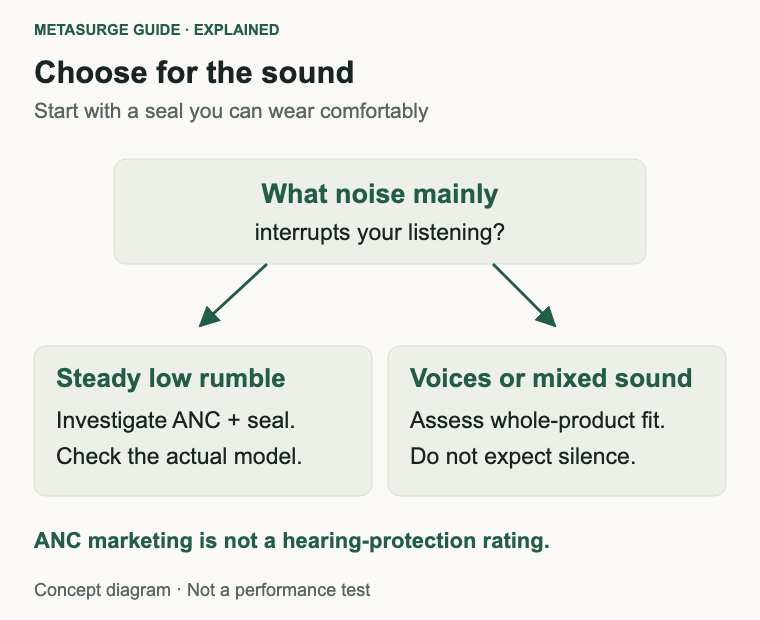
Steady low-frequency noise is a favourable target. Think of the continuous part of a vehicle’s engine sound or a ventilation system. Rapidly changing speech and abrupt noises are harder to reduce consistently. Actual performance varies by product and conditions, so no single description establishes how quiet your particular room will become.
Different models arrange microphones and processing differently. You may see feedforward, feedback or hybrid ANC descriptions. These describe approaches to sensing and control; they aren’t a universal ranking of finished products. More microphones or a more impressive label doesn’t establish a better result at your ears.
ANC doesn’t replace the physical fit. A product designed around a sealing tip needs that seal for its intended performance. Treat the tip and active system as parts of one design rather than trying to choose between them as if an ANC earbud contained no passive isolation.
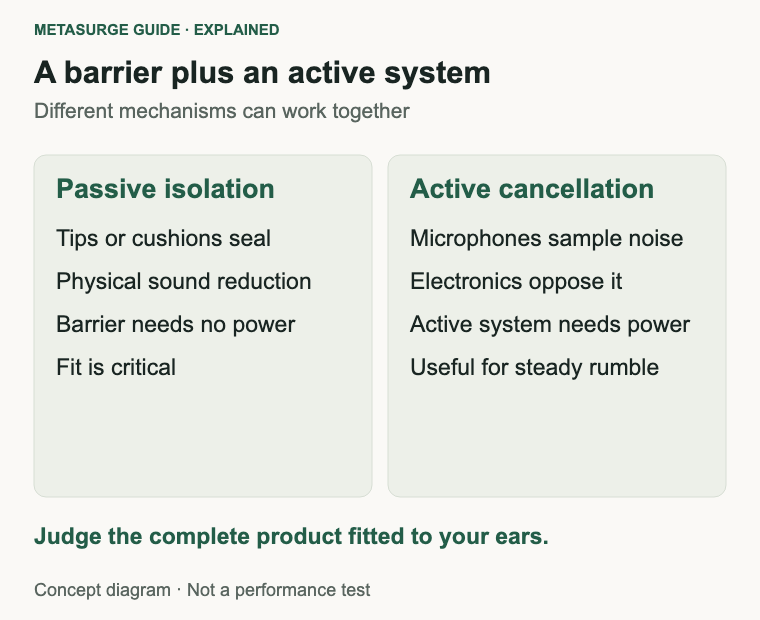
Which works better for the noise you hear?
| Noise or situation | Useful starting point | What to check |
|---|---|---|
| Steady train or aircraft rumble | ANC plus a good seal | Reduction with ANC on versus off |
| Voices and changing conversation | Fit and whole-product isolation | No promise of complete silence |
| A noisy shared room | Good seal, then ANC if useful | The particular sounds that interrupt you |
| Outdoor wind | Model-specific wind behaviour | Supported modes and microphone handling |
| Quiet-room listening | Comfortable fit and low distraction | Whether active processing adds noticeable hiss |
This is a set of checks, not a noise-reduction leaderboard. A well-sealing passive pair can be more useful than an ANC pair that doesn’t fit you. Another ANC product may add worthwhile rumble reduction on top of an equally good seal. Without comparable measurements and fit conditions, don’t declare a numerical winner.
If your main interruption is a nearby conversation, be realistic about the goal. Reducing a steady background hum may make the room feel calmer without making speech disappear. Decide whether that improvement helps your task instead of rejecting it solely because it doesn’t produce silence.
Fit is the first thing to troubleshoot
For earbuds, check the left and right markings, then follow the manufacturer’s fitting instructions. Try the supplied sizes and turn or position the buds as directed. Your left and right ears can suit different tip sizes. A manufacturer-provided fit check can help, although it doesn’t replace whether the fit remains comfortable.
Notice whether the seal changes when you speak or move. If you repeatedly push the earbud back into place, investigate another supported tip or a different shape. Don’t force a tip deeper simply to improve isolation. A fit that is secure only while uncomfortable isn’t a useful commuting or desk solution.
For over-ear designs, adjust the headband so the cushions surround the ears. Hair, a hat or glasses can leave a gap. Check with the glasses and clothing you normally wear. Repositioning may help, but pressing harder indefinitely isn’t a substitute for a shape that fits.
Inspect the parts too. Tips should be attached correctly, and removable cushions should be fully seated. Follow the cleaning and replacement instructions for the materials. A replacement tip or pad that physically attaches isn’t necessarily acoustically equivalent to the part the manufacturer designed around.
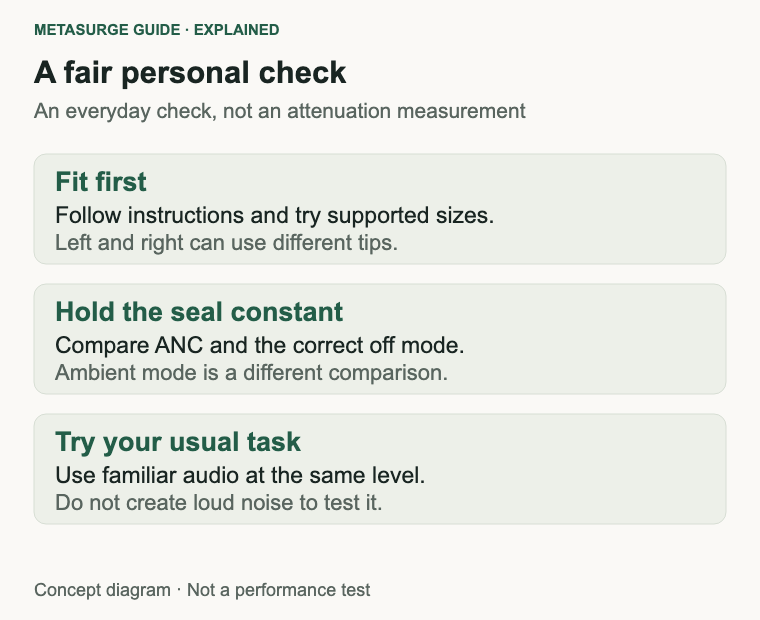
Compare ANC on and off without changing everything else
Use a familiar, ordinary environment where it is appropriate to wear headphones. Fit the headphones, leave the music paused and compare the supported noise-control modes. Keep the fit unchanged while switching, so you are assessing the active contribution rather than a new seal each time.
Distinguish off from transparency or ambient mode. An ambient mode deliberately brings external sound into the listening experience, so comparing ANC only against that mode may exaggerate what you think the electronics alone achieved. Read the manual to find the correct controls and whether a true off mode is available.
Next try familiar audio at the same comfortable level in each mode. Listen for whether rumble is reduced and whether the remaining distraction still matters. Don’t raise the volume to make one mode seem better, and don’t assume a reduction in distraction is the same as a measured reduction in sound exposure.
This is a personal buying check rather than a laboratory test. Room noise changes, your fit can shift and your impression has limits. It can still tell you whether a feature helps your normal situation without generating a misleading score or a claim that one product beats every alternative.
Why voices, wind and hiss can remain
Voices change quickly and contain a range of frequencies. ANC can reduce some components without removing the conversation. Physical isolation may help with parts that remain, but neither mechanism guarantees you won’t hear a person nearby. A short burst or a sudden sound can also remain noticeable.
Wind creates a separate problem around microphones. Sony documents situations where noise-cancelling or ambient modes can make wind noise more noticeable. The available remedy is model-dependent: check supported wind controls or another listening mode, rather than assuming your headphones have an automatic feature because another pair does.
Some active systems produce a low background hiss that becomes noticeable in a quiet room. That doesn’t prove that all ANC is noisy, nor does it mean every unusual sound should be ignored. Compare modes and consult the product’s troubleshooting guidance if the sound is new, strong or inconsistent with normal operation.
You don’t have to leave ANC enabled all the time. If passive isolation is sufficient at a quiet desk and you prefer the sound with processing off, use the supported mode that suits you. Then enable ANC when the environment gives it something useful to reduce.
Listening ANC isn’t microphone noise reduction
Listening ANC reduces unwanted sound reaching the wearer. Call microphone noise reduction aims to make the wearer’s voice clearer to somebody else. A product can offer one without the other, and the phrase “noise cancelling” in a listing can be ambiguous unless it says which function is meant.
Look for an explicit listening-ANC claim and the manual’s listening-mode controls. For calls, separately check microphone performance in the environment where you work. Don’t infer clear outdoor calls from strong rumble reduction, or infer quiet music listening from a claim about an AI microphone system.
Transparency is different again. It is useful when you want some surroundings fed through the headphones, but isn’t a guarantee that every warning, vehicle or announcement will reach you clearly. Pause or remove the headphones when your attention needs to be on the environment.
Power and comfort are practical trade-offs
ANC needs power; the passive barrier does not. That doesn’t mean every non-ANC headphone is battery-free. Bluetooth playback still needs powered electronics, and a wireless passive-isolating pair can stop playing when its battery is depleted even though the tips remain in place.
Check runtime for the mode you intend to use. A manufacturer’s ANC-off estimate doesn’t establish the time available with cancellation enabled. For true wireless earbuds, distinguish the earbud’s continuous playback from the total including recharges in the case.
If you want cable playback after the battery goes flat, confirm that behaviour explicitly. A socket or supplied cable doesn’t establish passive operation. Some designs need their electronics for particular modes even when a cable is connected.
Comfort deserves the same attention as the noise feature. A strong seal that you keep breaking because it hurts won’t provide a useful consistent experience. Choose the fit you can wear and the modes you can operate easily, rather than paying for a maximum cancellation claim you don’t enjoy using.
Don’t turn marketing claims into hearing-protection ratings
Consumer noise-control features are listening features unless the product has appropriate protection claims and evidence for the intended use. Don’t assume an advertised ANC reduction figure makes ordinary earbuds suitable protection around machinery, tools or other hazardous noise.
WorkSafe Victoria’s guidance explains that hearing protectors are selected using protection data and the noise conditions. That is a different decision from choosing headphones for a train trip. For a situation requiring hearing protection, follow the relevant workplace guidance and choose equipment specified for it rather than translating a headphone marketing claim into a safety rating.
Even for everyday shopping, treat “up to” figures cautiously. A maximum reduction at one frequency or under one test method doesn’t establish equivalent performance against all real-world sounds. Claims from different brands may not be directly comparable, and shouldn’t be combined or converted into a promised quietness percentage.
A buying checklist
- Identify your main noise: steady rumble, voices, wind or a changing mixture.
- Confirm whether the product offers listening ANC, microphone processing or both.
- Choose a comfortable seal and follow the fit instructions.
- Compare supported modes at a fixed fit and listening level.
- Check power needs, relevant runtime and any cable fallback.
- Read evidence for the exact product instead of comparing headline cancellation figures.
If passive isolation already meets your needs, you don’t need to add electronics for their own sake. If engine rumble remains distracting after you get a good seal, ANC is worth investigating. The right choice is the whole product that helps with your noise and remains comfortable to use.
Frequently asked questions
Does ANC work without music?
Some models let you use it while playback is paused. Confirm the manual and power requirements for the particular pair; behaviour and automatic shut-off settings can vary.
Do foam tips always isolate better than silicone?
No universal result follows from the material name alone. The supported design, size, fit and condition matter. Choose compatible tips and follow their instructions.
Does a noise-cancelling microphone block noise for me?
Not by itself. That claim concerns sound sent to the other person. Look separately for listening ANC if you want electronic reduction of what reaches your ears.
Should I expect total silence?
No. The result depends on fit, the noise and the product. ANC and passive isolation can reduce distraction without eliminating every voice or sudden sound.
Relevant examples to explore
Editorial examples, separate from Best Sellers rankings. Within each group, products are ordered by Amazon Best Sellers position captured 17 October 2026; positions can change.
As an Amazon Associate MetaSurge Guide earns from qualifying purchases. Check current details, price and availability on Amazon before buying. Country detection by DB-IP.
Sources and editorial approach
Mechanisms and limits use Sennheiser’s ANC guidance and Shure’s isolation explanation. Fit checks also use soundcore’s tip guidance; wind behaviour uses Sony support. Hearing-protection distinctions follow WorkSafe Victoria. Sources checked on 15 October 2026. Shure’s older product-specific superiority claims aren’t adopted as a ranking of current headphones. MetaSurge hasn’t measured attenuation; buying checklists are editorial interpretation.
Where to go next
Explore the MetaSurge in-ear headphone category once you know the noise-control feature and fit you want. The examples above illustrate an ANC design and a wired passive-isolating design, without claiming which will block more noise for your ears.