
A budget pair of in-ear headphones is enough if it fits comfortably, sounds good to you and handles the places where you listen. Spending more becomes worthwhile when it solves a specific problem: better noise control on your commute, clearer calls, easier device switching or controls you use every day.
Price alone doesn’t establish any of those benefits. A premium pair with an awkward fit can be a worse purchase than a simpler pair you can wear comfortably. Nor does a long feature list tell you how well those features work with your phone and routine.
Start by naming what disappoints you about your current pair. If you can’t identify a problem beyond wanting something more expensive, keep using it while you work out what would actually improve your listening.
Decide what the extra money must improve
Think about your busiest listening situation. You might use headphones mainly for podcasts in a quiet room, music on a train or calls between a laptop and phone. Each situation puts different demands on the product, so a single premium label is a poor buying brief.
For quiet-room podcasts, comfort, intelligible speech and simple controls may be enough. On a noisy commute, the combination of a good seal and effective noise control becomes more valuable. For work calls, the microphone and connection behaviour can matter more than an extra listening mode.
Separate the sound you hear from the sound other people hear. A pair can be enjoyable for music yet inconvenient for calls in wind or background chatter. A marketing reference to noise cancellation may describe listening ANC or call processing; check which problem the feature addresses.
Make a short priority list before comparing products. Give each desired feature a job: multipoint for moving between work calls and a phone, a particular control for adjusting playback without reaching for the screen, or a smaller case for a pocket. Features without a job can stay optional.
Budget doesn’t have to mean buying the cheapest listing you can find. Look for a clear product identity, reliable documentation, suitable support and a seller you can deal with if something goes wrong. Compare the total purchase on those terms rather than choosing by a large discount badge.
Equally, a higher original price doesn’t establish the current value of an older model. Prices and offers change. Compare the actual amount you would pay, the features you would use and the support position at the time of purchase.
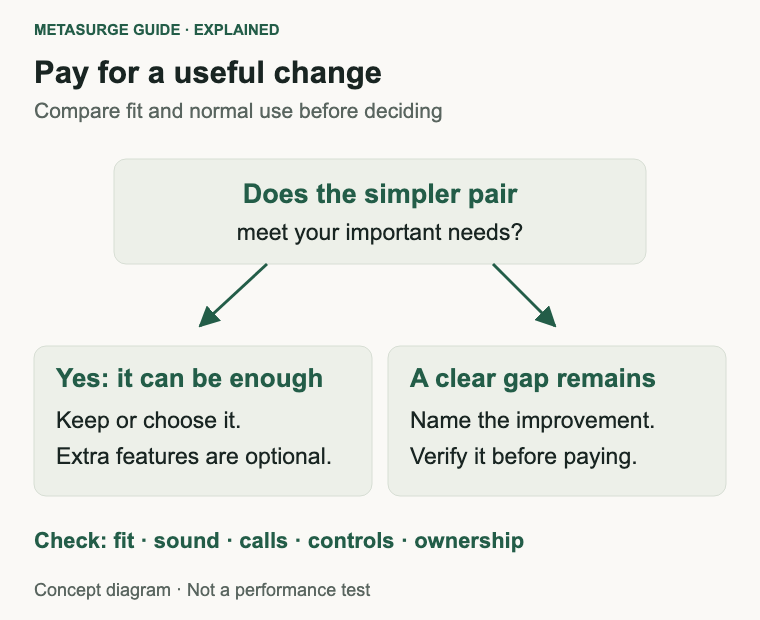
A useful test is to finish this sentence: “I’d pay more because this pair lets me do something my current pair doesn’t.” If the answer is concrete, you have something to investigate. If it’s simply “premium should sound better”, you’ll need a closer comparison before spending.
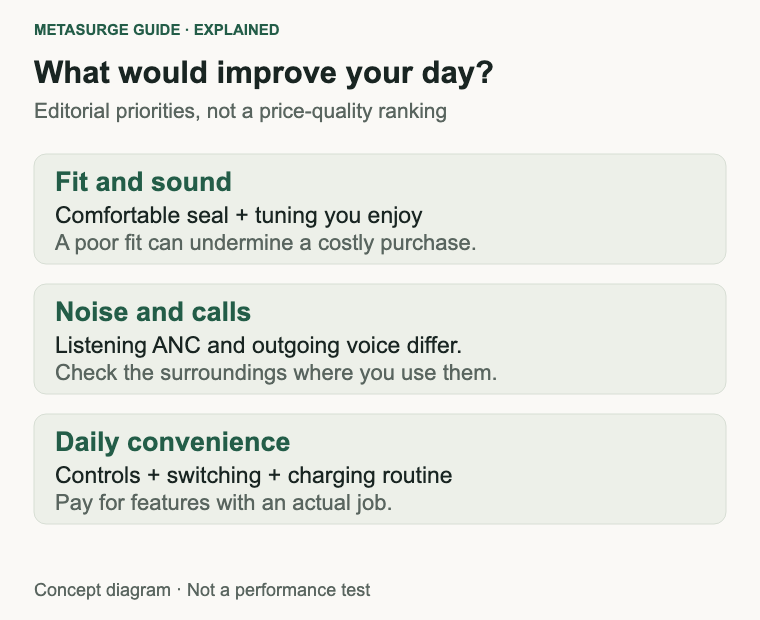
Get the fit right before judging the sound
The ear tip and your ear form part of the listening system. A poor seal can change the bass you hear and allow more outside noise into the experience. Shure’s earphone guidance identifies fit as an important influence on sound, and Sony’s troubleshooting similarly connects gaps around a tip with weaker noise cancellation.
Try the supplied tip sizes using the manufacturer’s instructions. Your left and right ears may need different sizes. The goal is a stable, comfortable seal, not forcing the largest tip into place or repeatedly pushing the earbud deeper.
Check the fit while you talk and move normally. A pair that seals while you sit still may loosen when you walk or move your jaw. Notice whether you keep adjusting it, whether the shell presses against your outer ear and whether the controls disturb its position.
Give comfort time to become apparent. An immediately secure fit isn’t necessarily one you’ll enjoy through a train journey or a long work session. If you can try a pair, use an ordinary listening period rather than judging it solely during a quick first impression.
A compatible replacement tip can be worth investigating, but check attachment, dimensions and charging-case clearance. Tips are not universally interchangeable. Follow any care instructions for the material and don’t assume a foam or silicone alternative automatically improves isolation or comfort.
Then assess tuning: the balance of bass, voices and higher sounds. “More bass” isn’t the same as clearer sound, and a presentation one listener enjoys may not suit another. Use familiar speech and music so that you can recognise what changes.
An equaliser can help adjust preferences where the product and app support it. It cannot create a comfortable physical fit or guarantee that two different earphones become equivalent. Try sensible settings before assuming you need to replace hardware.
Treat driver counts, large drivers and very wide advertised frequency ranges as design information. They don’t independently establish how balanced or enjoyable the finished product will sound. The useful question remains whether you prefer the result at a comfortable listening level.
Compare noise control, calls and connection features
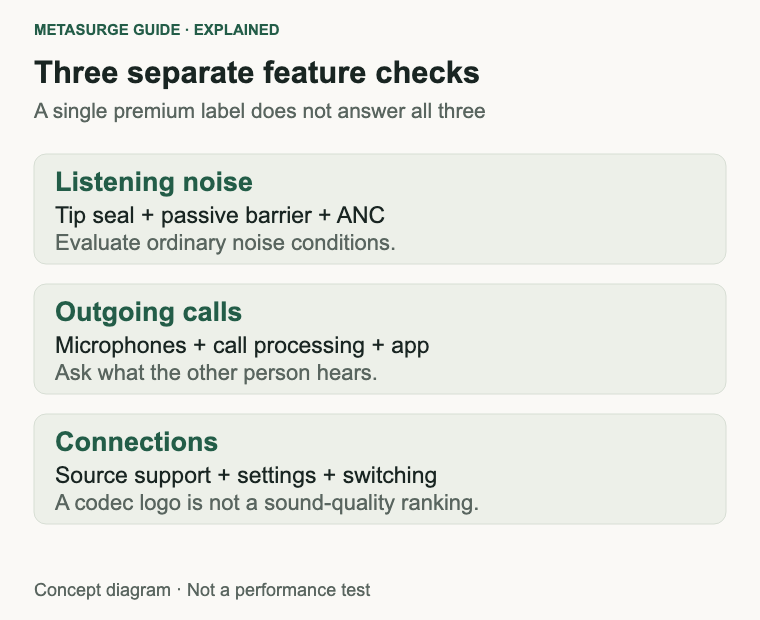
Passive isolation is the physical barrier created by the tips and earphone fit. Active noise cancellation uses microphones and processing to reduce unwanted sound. Many in-ear designs use both, so comparing ANC with “no isolation” misrepresents how they work.
Look for evidence relevant to your environment. Steady transport noise, changing voices and wind are different conditions. A single percentage or “up to” figure does not establish that one pair will suit all of them, especially when the testing conditions differ.
Call noise processing has another job: helping the person at the other end hear your voice. Check call behaviour in the app and connection mode you use. A favourable music demonstration doesn’t tell you how well the microphone handles your normal surroundings.
Device switching can justify spending more if it removes a daily frustration. Confirm whether the pair supports simultaneous connections, how incoming calls interrupt playback and whether the feature works with your devices. Saving several pairings is not necessarily the same thing as maintaining two active connections.
Codec support also involves both ends of the link. A codec listed on the earphones may require a compatible phone, a particular setting or a trade-off with another feature. Check the full combination rather than paying for a logo your source cannot use.
Don’t turn a codec into an automatic sound-quality ranking. The recording, settings, fit and listening conditions still matter. A feature that is technically supported can be less valuable to you than reliable switching or a control you can operate easily.
Try ambient or transparency modes if you regularly speak to people while wearing the earphones. Assess how natural and convenient they feel. Their presence does not guarantee that every outside sound will remain clear, and they should not become a reason to ignore your surroundings.
For a useful comparison, keep the categories separate: listening noise control, outgoing voice quality, connection behaviour and controls. That makes it easier to see whether the extra cost addresses your actual priorities or merely adds capabilities you rarely use.
Count the ownership costs as well as the features
Battery claims need careful reading. Playback on one charge is different from a combined total that includes charging from the case. ANC, connection settings, volume and other enabled features can affect the result. Check the manufacturer’s conditions before comparing headline hours.
Consider how you charge rather than simply wanting the largest number. A pair that reliably covers your usual journey and fits your charging routine may already be sufficient. Longer claimed endurance can still matter for travel or long workdays, but it is useful only if the rest of the design suits you.
Investigate replacement and service arrangements. Can you obtain compatible tips, a replacement case or help for a lost earbud? Does the manufacturer explain battery service? Don’t assume that a more expensive pair has an owner-replaceable battery or that a convenient part will remain available indefinitely.
Controls deserve a practical check. Touch gestures can be convenient, but some listeners prefer buttons or a different arrangement. Check accidental activation, access with your usual clothing and whether the controls you need can be customised on your phone.
Read water-resistance wording precisely. A rating can apply to the earbuds without applying to the charging case, and the manufacturer may specify particular limits. It is not a blanket promise about swimming, cleaning or every type of exposure.
App support is part of ownership too. Check device compatibility, account requirements and whether features require the app to remain installed. If you’re buying for a work device with software restrictions, a feature available only through an unavailable app has little value.
Keep warranty and return arrangements separate from feature claims. Before buying, understand the seller’s stated process and any trial or change-of-mind conditions. Trying in-ear products can involve retailer-specific conditions, so don’t assume that a short home audition is available everywhere.
There is also a reasonable keep option. If your current pair works comfortably and the battery still covers your needs, you can wait. Replacing it because a new generation exists is a preference, not a requirement created by the specification sheet.
Make a fair comparison and choose
Use the same familiar recordings and the same source where practical. Check that streaming quality, equaliser and listening modes are comparable. If you’re changing several settings at once, it becomes hard to know what caused the difference you prefer.
Keep the volume at a comfortable level and make the perceived loudness broadly similar. A louder demonstration can seem more impressive without resolving the question you intended to ask. Volume-slider positions are not a dependable way to match different earphones.
Test the tasks you prioritised. For commuting, assess fit and noise control in ordinary surroundings. For work, check calls and switching. For home listening, spend more time with the voices and music you actually use than with a specially selected showroom track.
Write down the result in practical terms: fewer interruptions, a more stable fit, a voice the other person can understand or controls that save reaching for the phone. Those observations are easier to judge than a vague expectation of “premium detail”.
Choose the budget option when it meets the important requirements and the remaining differences would rarely change your day. Choose the more expensive option when a verified feature or a clear personal preference is valuable enough to justify the actual additional cost.
Avoid making the decision into a contest between all cheap and all premium earphones. Models differ, and prices move. A particular feature-rich pair can be worthwhile without proving that every expensive pair is better than every affordable one.
For an existing owner, compare against keeping what you have. Buying another pair needs to improve on the current experience, not merely look stronger than a hypothetical basic product. A compatible tip or a useful setting may be a smaller first step.
Your final checklist can be short: comfortable fit, preferred sound, useful noise control, adequate calls, reliable connections and a manageable ownership routine. Spend more where it improves one of those things enough for you to notice and care.
Frequently asked questions
Do expensive earbuds always sound better?
No. Fit, tuning, source settings and your preferences all affect the result. Price can reflect extra features and design choices rather than a sound improvement you personally value. Compare the exact models and your actual purchase prices.
Is ANC worth paying extra for?
It can be if it helps in the places you listen. Check the fit first and compare relevant noise conditions. ANC is a listening feature; call noise processing has a separate purpose.
Are more drivers or a better codec enough reason to upgrade?
Those specifications alone don’t establish an audible improvement. Codec support needs a compatible source and settings, while the finished tuning and fit remain important. Identify a practical benefit before paying for the specification.
Should I replace a working budget pair?
Only if you want an improvement you can identify and justify. If it remains comfortable, reliable and suitable for your routine, keeping it is reasonable. A new model does not create an automatic need to upgrade.
Relevant examples to explore
Editorial examples, separate from Best Sellers rankings. Within each group, products are ordered by Amazon Best Sellers position captured 17 October 2026; positions can change.
As an Amazon Associate MetaSurge Guide earns from qualifying purchases. Check current details, price and availability on Amazon before buying. Country detection by DB-IP.
Sources and editorial approach
Fit principles were checked against Shure’s earphone guidance and Sony’s noise-cancellation troubleshooting. Feature distinctions use manufacturer specifications, checked on 16 October 2026. The comparison method is editorial reasoning, not hands-on product testing. No universal price bands, measured sound advantages or current retail prices are asserted.
Where to go next
Use the In-Ear Headphones guide after choosing the features that matter to your routine. The separate examples illustrate different feature sets; confirm the fit, exact variant and current purchase conditions before deciding.